
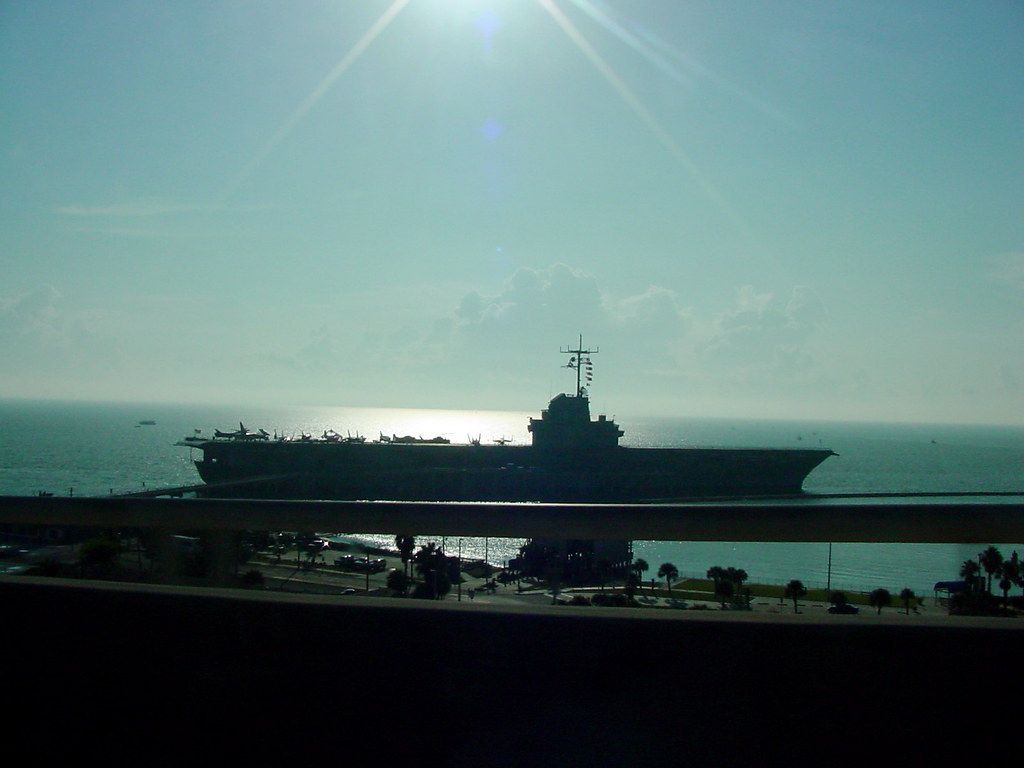
Corpus Christi sits on a curve of its own bay, and the city has spent most of a century arranging itself to face the water. Downtown stands on low ground at the foot of a bluff, protected by a long stepped seawall. North of the ship channel lies North Beach, a narrow peninsula of sand that now holds the city's two biggest attractions: an old aircraft carrier and the state aquarium. Above both arches the bridge that carries the highway over the channel, with tankers and cargo ships passing underneath.
Coming from Rockport, Corpus Christi is the nearest city and a good change of pace from the small bay towns. You can see the essentials in a day, walk a good part of it, and still be back for sunset over the water further north.
The seawall and the miradores
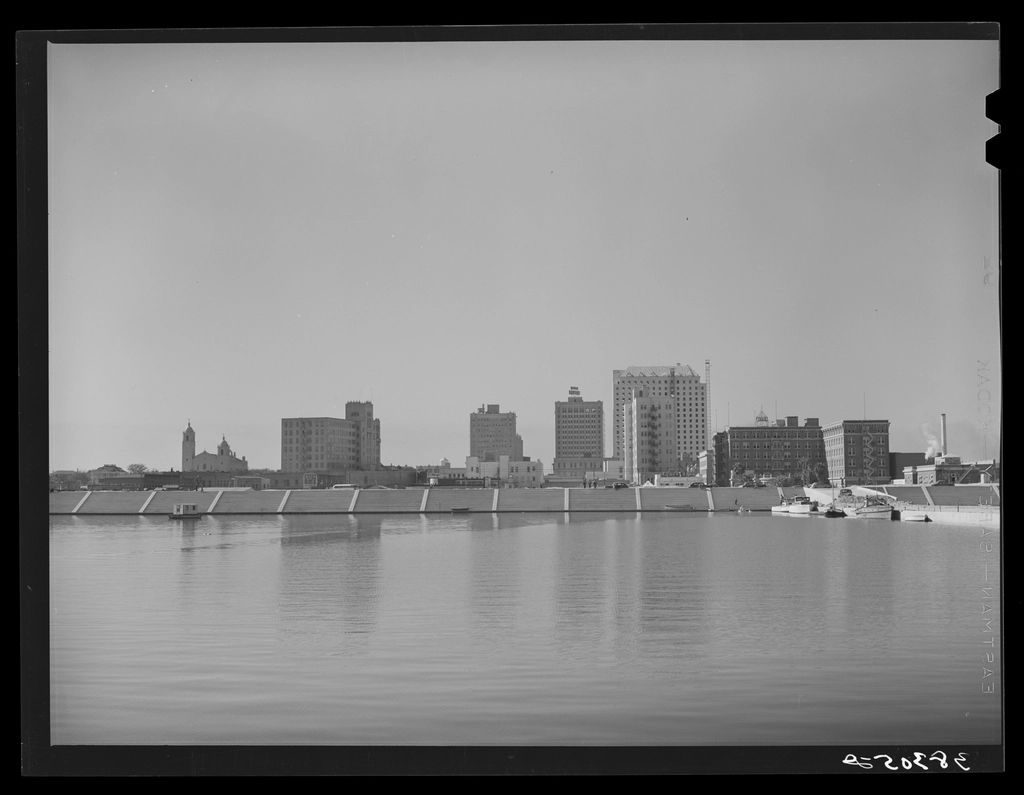
The seawall was built in the late 1930s and early 1940s, after storms had flooded the low part of downtown, and it was designed to be walked on as well as to hold back the water. Broad concrete steps lead down towards the bay along its whole length, and a wide promenade runs along the top beside Shoreline Boulevard. People sit on the steps to fish, to talk and to watch the sailboats.
Along the promenade stand the miradores, small open pavilions with domed roofs and white columns, built in a Spanish colonial style. They give you shade and a frame for the view. One of them, the Mirador de la Flor, is a memorial to the singer Selena, who grew up in Corpus Christi, and there are often flowers at the foot of her bronze figure.
Walk the seawall in the morning if you can. The wind on this part of the coast tends to build through the day, and by mid-afternoon in spring it can be strong enough to whip spray over the steps. The city's marina sits in the middle of the bayfront, behind its own breakwaters, and in the early light you can watch boats heading out and pelicans perched on the pilings.
Upper Broadway and the bluff
Behind the seawall, the ground rises sharply to the bluff, where the older city grew up along Upper Broadway. A set of terraces and stairways climbs the slope, and from the top you look straight out across the rooftops to the bay. The cathedral, with its twin towers and domes, has stood on the bluff since 1940 and remains one of the most recognisable shapes on the skyline.
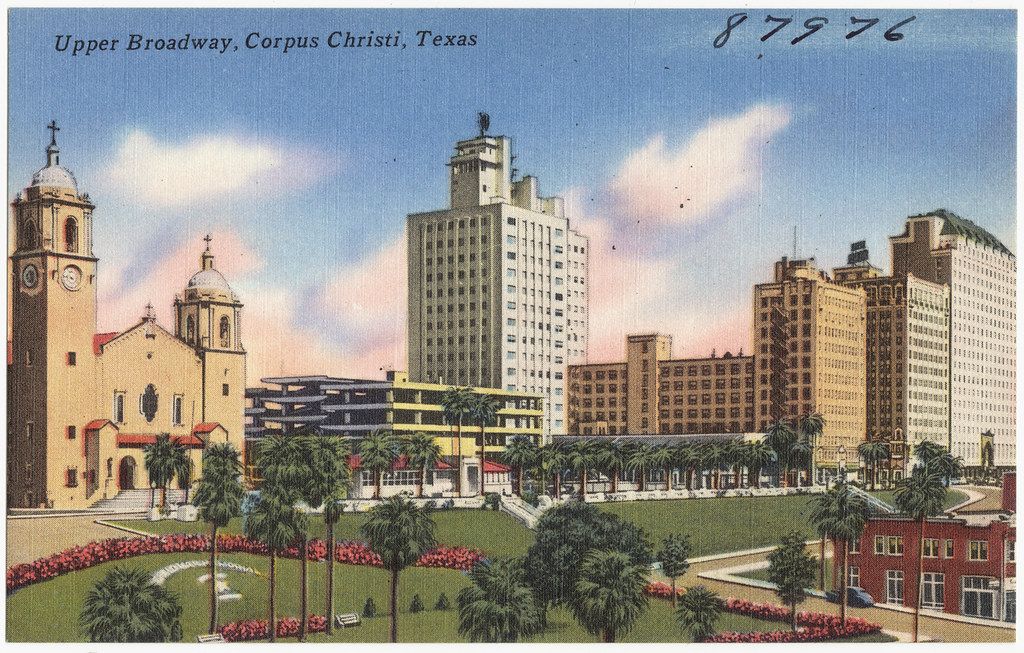
Old postcards of this view show the bluff gardens planted with palms and flowers, and the same layout survives today, with taller towers behind. It is a short, steep walk from the bayfront and worth it for the perspective. You understand better how the city stands on two levels, and how much the seawall shapes the lower one.
North Beach: the ship and the aquarium
Across the ship channel, North Beach is a different world, with motels, a public beach on the bay and two big attractions next to each other. The first you see from far away. The USS Lexington, an aircraft carrier that served from the Second World War until the early 1990s, is moored off the beach as a museum. Its long grey flight deck is lined with aircraft from several eras, and inside you can walk through hangar decks, crew quarters and the bridge. Plan on several hours; it is a big ship, and the stairs are steep.
Down the road · IslandsPadre Island National Seashore and the sea turtlesThe Texas State Aquarium stands next door and concentrates on the Gulf of Mexico and the Caribbean. Its tanks recreate the reefs and offshore platforms of the Gulf, and there are outdoor exhibits with dolphins and shorebirds. It also runs a rescue and rehabilitation centre for injured wildlife, including sea turtles and birds from the bays you will have seen around Rockport.
Admission to both is charged separately. Both are busiest on summer weekends and school holidays. A weekday in the cooler months is calmer, and it is easy to combine one of them with a walk along the sand of North Beach afterwards.
Both are busiest on summer weekends and school holidays.
The art museum and the bridge
Back on the downtown side, near the ship channel, the Art Museum of South Texas occupies a bright white building of angular concrete that looks out over the water. It is a striking piece of architecture in its own right, and its galleries show changing exhibitions as well as art from Texas and the region. The museum's windows frame the bay like large pictures. Nearby, museums of science and history sit in the same waterfront district, so you can make an afternoon of it without moving the car.
Between the museums and the water, a stretch of lawns and paths runs along the channel, and it is one of the best places in the city to watch shipping. Tankers, cargo ships and the occasional naval vessel move slowly through the channel towards the inner harbour, close enough that you can read the names on their hulls. Pilot boats and tugs dart around them. On a still evening the lights of the port come on one by one, and the sound of engines carries across the water long after dark.
The bridge over the ship channel has long been the city's signature, a high arched span that carries US 181 north towards Portland and the road home to Rockport. A taller replacement bridge has been built beside it, and depending on when you visit you may drive one or the other. Either way, the crossing gives you a sudden view down onto the port, the refineries along the inner harbour and the ships waiting in the channel.
A day that works
Drive down from Rockport after breakfast, park near the bayfront and walk the seawall while the air is still. Climb to the bluff for the view, then cross to North Beach for the ship or the aquarium in the middle of the day, when the wind and heat are at their strongest. Late in the afternoon, the art museum is a cool, quiet place to end, before the drive back north as the light goes gold over the bay.
If you have more time, Corpus Christi is also the gateway to the island beaches to the south. The road out across the causeway leads to Padre Island National Seashore, and the coast road north takes you to Port Aransas and the ferry. For the drive itself, the notes on highways, causeways and the ferry cover the routes in and out.
Picture credits: TravelingOtter – Creative Commons BY-SA 2.0; Boston Public Library – Creative Commons BY 2.0; libraryofcongress – CC0 1.0 Universal.