
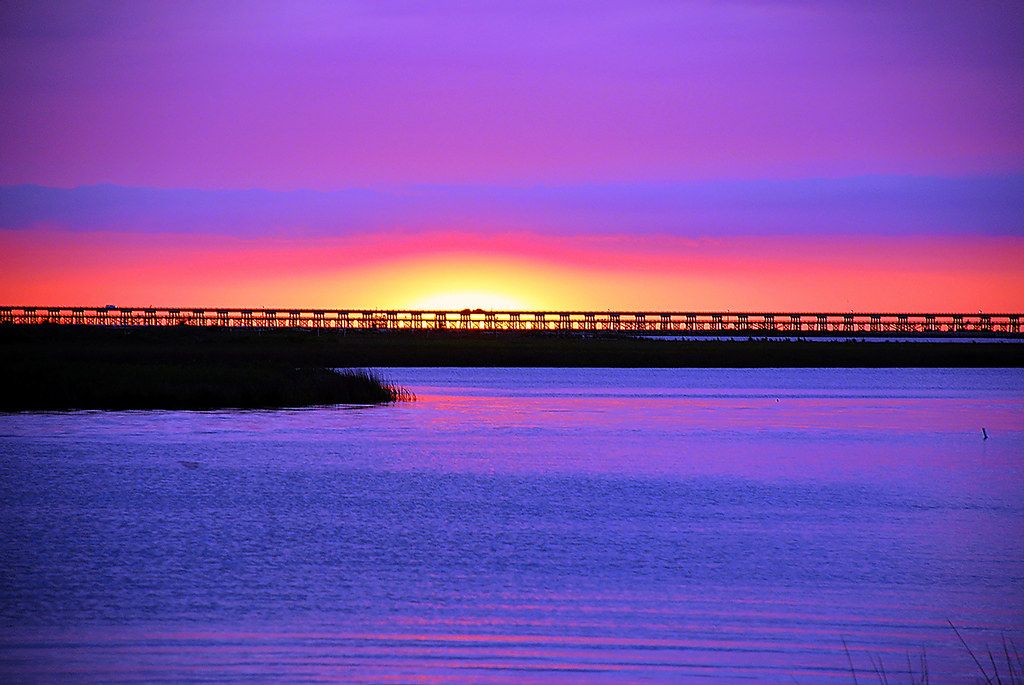
Drive north from Fulton on Highway 35 and the land runs out. The road rises onto a long, high bridge across Copano Bay, and for a minute or two you are surrounded by water: the wide bay to the west, the narrower mouth toward Aransas Bay to the east, and the low green line of the Lamar Peninsula ahead.
Beside the modern bridge, you will notice the remains of the old causeway. When the new crossing was built, sections of the old roadway at either end were kept as fishing piers, and they have become some of the best-loved places on the Coastal Bend to cast a line, watch birds or simply sit through a sunset.
The old causeway piers
The piers run out from both shores, long and straight, following the line of the old road. Their width makes them feel more like a promenade than a narrow pier, and on a calm evening you can walk a long way out over the water with plenty of room.
Storms have taken their toll. Hurricane Harvey in 2017 damaged the piers, and repairs took time. Sections may be closed for safety. What is open on one visit may be different on the next.
The piers are working places as much as scenic ones. Anglers set up with buckets, coolers and lights, and on a good evening the railings are lined with rods. Be careful of lines and hooks as you walk, and give people room to cast.
Fishing the bay
Copano Bay is shallow and broad, fed by rivers from the north and connected to Aransas Bay through a narrow mouth. The mix of fresh and salt water makes it rich in fish, crabs and oysters. Anglers from the piers catch redfish, speckled trout, black drum, sheepshead and flounder, depending on the season and the tide.
A Texas fishing licence is required, and bag and size limits apply. The state can close areas or species at short notice. Shellfish harvesting has its own rules and closures, covered in the guide to oysters, shrimp and the bay seafood season.
Night fishing is popular in the warmer months, when lights on the piers draw bait fish and the larger fish that follow them. The air is cooler, the water is calm, and the stars come out over the bay.
Down the road · Bays and birdsGoose Island and the oak that has outlasted every stormSunsets over the water
The real draw for many visitors is the sunset. From the piers, you look west across Copano Bay as the sun sinks toward the low shore, and on a clear evening the sky fills with orange, pink and violet. The new bridge stands out in silhouette, a long dark line against the colour.
A calm evening turns the bay into a mirror, doubling the colour in the water. A north wind breaks it up into chop and spray. Either way, it is worth arriving early, finding a spot along the railing and letting the light change around you.
Bring a jacket, even in mild weather. Once the sun is down, the breeze off the water can turn cool quickly, especially in winter.
Pelicans, skimmers and gulls
The piers are as popular with birds as with people. Brown pelicans perch on the pilings and railings, waiting for scraps from the anglers, and glide low over the water in long lines. Laughing gulls patrol the piers, squabbling over bait. Terns hover and dive for small fish.
Look out for black skimmers, striking black-and-white birds with long, uneven bills. They fly low over calm water with the lower half of the bill slicing through the surface, scooping up small fish as they go. Evening is often the best time to see them.
In winter, ducks and other waterbirds raft out on the open bay. The marshes and flats at the edges of the bay hold herons, egrets and spoonbills. The guide to spring migration and the Connie Hagar sanctuaries covers the wider story of birds on this coast.
A bay with a long history
Copano Bay has been part of human life on this coast for a very long time. The Karankawa and other Native peoples fished and gathered shellfish along its shores for centuries. Under Spain and then Mexico, a small port called El Copano on the north shore served as a landing place for supplies and settlers heading inland. Little remains of it today beyond scattered ruins on private land.
Later, the bay became the domain of ranchers, fishermen and oystermen, and in the twentieth century the causeway opened the Lamar Peninsula to easy travel from Fulton and Rockport. The towns grew, and the bay became a place for leisure as well as work.
Making the most of a visit
- Come in the late afternoon, stay through sunset, and leave before full dark if you are not fishing.
- Watch your step on the piers; boards and concrete can be slippery and uneven.
- Keep an eye on children near the edges and the railings.
- Carry out all rubbish, including fishing line, which can tangle and kill birds.
- In storm season, follow official forecasts; the piers close during severe weather.
Copano Bay fits easily into a wider day. North of the bridge lies Goose Island State Park and its ancient oak. In winter, the whooping cranes of Aransas National Wildlife Refuge are within reach to the northeast. South of the bridge, the bayfront road leads back past the house described in the guide to the Fulton Mansion on Aransas Bay.
Picture credits: S.A. Street Photographer – Creative Commons BY 2.0.